
Hevo supports a number of databases and data warehouses as Destinations. You can use Hevo API to create and work with Destinations for your data Pipelines. Read Create Destinations to know about the endpoints available.
You need to provide the Basic token to make the API request for creating the Destination. The Basic token is the combination of your Access and Secret Keys from your API Key. Read Generating your API credentials for steps to generate your API credentials.
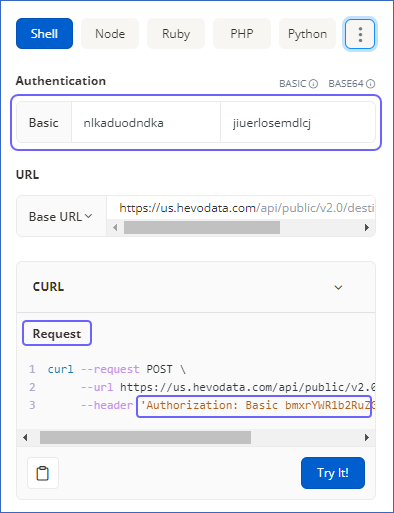
Once you provide the Basic token in the Authorization header of the request, you can specify the Destination details, such as its name, type, and configuration settings, in the API request body.
Here are a few sample API requests for creating Destinations using Hevo API:
Snowflake
Snowflake offers a cloud-based data storage and analytics service, generally termed as data warehouse-as-a-service. Companies can use it to store and analyze data using cloud-based hardware and software. Read more about Snowflake as a Destination.
You can create a Snowflake Destination that connects using
access credentials or a private and public key pair.
In the API Request:
- Replace the values in the sample API request given below with your own to create your Snowflake Destination.
- For the
regionparameter, specify the region in which your Snowflake account is located. Read obtain your Snowflake account URL. - For the
account_nameparameter, specify the Snowflake account identifier. Read obtain your Snowflake account name. - For the connection parameters, specify one of the following:
- Connect using Access Credentials:
- Set
authentication_typeto PASS. - Specify
db_useranddb_password.
- Set
- Connect using a Key Pair:
- Set
authentication_typeto KEY_PAIR. - Set the
db_userto whom the public key is assigned in your Snowflake database. - Set
private_keyto the private key associated with the assigned public key. Include the entire private key text. Ensure that the text between-----BEGIN ENCRYPTED PRIVATE KEY-----and-----END ENCRYPTED PRIVATE KEY-----does not contain any line breaks. - Set the
passphraseto the password given while generating the encrypted private key. Leave it blank if using a non-encrypted private key.
- Set
- Connect using Access Credentials:
- Set
populate_loaded_timestampto true to append the__hevo_loaded_atcolumn to the Destination table to indicate the time when the Event was loaded to the Destination. Else, set it to false. - Set
create_transient_tablesto true if you do not need Snowflake to back up your data tables, as they can be recreated outside of Snowflake. Read Transient Tables.
curl --location -g --request POST  'https://us.hevodata.com/api/public/v2.0/destinations' \
--header 'Authorization: Basic <auth_token>' \
--header 'Content-Type: application/json' \
--data-raw
    '{
        "name": "snowflake_dest_name", // replace "snowflake_dest_name" with a name for the Destination
        "type": "SNOWFLAKE",
        "config": {
            "region": "ap-south-1", // replace with region found in the Snowflake account URL
            "account_name": "sf_org-sf_acc", // replace "sf-org-sf_acc" with your Snowflake account identifier
            "authentication_type": "PASS",
            "db_user": "super_user", // replace "super_user" with user you created for Hevo
            "db_password": "password", // replace with the user password
            "warehouse": "COMPUTE_WH", // replace "COMPUTE_WH" with your warehouse name
            "db_name": "sf_db", // replace "sf_db" with the name of your database
            "schema_name": "PUBLIC", // replace "PUBLIC" with the database schema name
            "populate_loaded_timestamp": true,
            "create_transient_tables": false
        }
    }'
curl --location -g --request POST 'https://us.hevodata.com/api/public/v2.0/destinations' \
--header 'Authorization: Basic <auth_token>' \
--header 'Content-Type: application/json' \
--data-raw
'{
"name": "snowflake_dest_name", // replace "snowflake_dest_name" with a name for the Destination
"type": "SNOWFLAKE",
"config": {
"region": "ap-south-1", // replace with region found in the Snowflake account URL
"account_name": "sf_org-sf_acc", // replace "sf-org-sf_acc" with your Snowflake account identifier
"authentication_type": "KEY_PAIR",
"db_user": "super_user", // replace "super_user" with the user that is assigned the public key created for Hevo
"private_key": "-----BEGIN ENCRYPTED PRIVATE KEY-----\nMIIFJDBWBgkqhkiG9w0BBQ0wSTAxBgkqhkiG*****************************************************************************************************************************v0j36rFX8XeKiJqh2TwBvn/v\n-----END ENCRYPTED PRIVATE KEY-----\n", // replace with the associated private key
"passphrase": "S****3", // replace with passphrase for your encrypted private key
"warehouse": "COMPUTE_WH", // replace "COMPUTE_WH" with your warehouse name
"db_name": "sf_db", // replace "sf_db" with the name of your database
"schema_name": "PUBLIC", // replace "PUBLIC" with the database schema name
"populate_loaded_timestamp": true,
"create_transient_tables": false
}
}'Google BigQuery
Google BigQuery is a fully managed, serverless data warehouse that supports Structured Query Language (SQL) to derive meaningful insights from the data. Read more about Google BigQuery.
In the API Request:
- Replace the values in the sample API request below with your own to create your Google BigQuery Destination.
- Set
populate_loaded_timestampto true to append the__hevo_loaded_atcolumn to the Destination table to indicate the time when the Event was loaded to the Destination. Else, set it to false. - Set
enable_streaming_insertsto true to stream data to your BigQuery Destination as it gets received from the Source instead of loading it via a job as per a defined Pipeline schedule. Else, set it to false.
curl --location -g --request POST 'https://us.hevodata.com/api/public/v2.0/destinations' \
--header 'Authorization: Basic <auth_token>' \
--header 'Content-Type: application/json' \
--data-raw '{
           "name": "bq_dest_name", // replace "bq_dest_name" with the name you want for your Destination
           "type": "BIGQUERY",
           "config": {
                   "project_id": "hevo-test-project", // replace "hevo-test-project" with your projectID in BigQuery
                   "dataset_name": "hevo_test_dataset", // replace "hevo_test_dataset" with your Dataset ID
                   "bucket": "hevo-test-bucket", // replace "hevo-test-bucket" with your GCS bucket
                   "oauth_account_id": 1, // replace "1" with your Oauth client ID
                   "sanitize_name": true,
                   "populate_loaded_timestamp": true,
                   "enable_streaming_inserts": false,
                     }
            }'
MySQL
Hevo can load data from any of your Pipelines into a MySQL database. Read MySQL.
In the API Request:
- Replace the values of the parameters given in the sample API request below with your own to create your MySQL Destination.
- Set
sanitize_nameto true to remove all non-alphanumeric characters and spaces in a table or column name and replace them with an underscore. Else, set it to false.
Read Configure MySQL settings for details on other configuration parameters.
curl --location -g --request POST
'https://us.hevodata.com/api/public/v2.0/destinations' \
--header 'Authorization: Basic <auth_token>' \
--header 'Content-Type: application/json' \
--data-raw '{
          "name": "mysql_db", // replace with the name you want for your Destination.
          "type": "MYSQL",
          "config": {
                 "db_host": "demo.mysql.com", // replace with your MySQL host’s IP address or DNS
                 "db_port": 5439, // replace with the port on which your MySQL server is listening for connections
                 "db_name": "demo", // replace with your Destination database name
                 "db_user": "root", // replace with a user that has non-administrative role of the MySQL database
                 "db_password": "dbpassword" // replace with the user's database password
                 "sanitize_name": false
                    }
            }'